The Full Story
Bettisville: Hidden in Plain Sight
There’s only room for one Trump Man in this town within a town.
As far as I could see, there was road. Road and mountains, which firmly stopped the road as it ached toward the line of slouched tree canopies. The white painted midline, outstretched in long, parallel lines and short hyphens, straddled the way there and the way back; they blurred to one extending eternity. I passed the signpost marking the town of Hartford as quickly as I passed its village—empty window shops, abandoned brick buildings and one gas station.
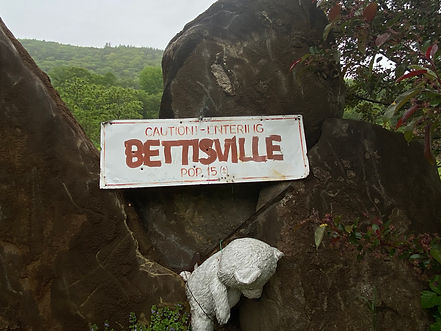
I arrived at my destination – Bettisville. Population: 15 (plus or minus). It was hand-written on the signpost tucked between slabs of stone. They were mounted atop each other to form a wall. It town was a town within a town. Really, it was just a single-family home with a garage and a sugar shack and grassy land along the White River. A couple of trucks and tractors. A lot of signposts and stone walls. Municipality was just a formality in this case.
This place belonged to Bob Bettis and it was Bob Bettis who founded this town. The sign floated by my window with the rest of the green landscape -- swells of fertile springtime pines and sweet nectar blew strongly through the air.
When I stopped to read the sign, I saw more. I parked my car under a canopy of trees, and pulled to the side of the road, bordering a small, wooded fence in front of the residence. But it felt too close. Putting the car in reverse, I drove back a hundred feet.
Weeping elms’ sunken branches fell over me and offered me protection from the afternoon sun and the occasional cars which passed in a crescendo and decrescendo of noise and wind. It blew hair into my visage and lulled the screaming rapids on the banks of the White River behind the house. Clusters of ragweed pollen floated lightly and gently in wisps, as they tended to land on the sticky ends of ends of tree branches. Here, in a few weeks’ time, the blossoms would be tended to by the little brown birds – those which hopped around on two feet, scavenging for seeds. They would find lots here.
The lawn in front of the stone slabs was polluted with dandelions, sprouting up through the crab grass, milkweed, and the posts of campaign signs spiked into the ground. Make America Great! Little birds hopped around obliviously. Another sign: Let’s Rock. 1963. Another. Caution: Entering Bettisville.
When Bob Bettis invited me into his home, I swooned. At the four-seasons porch, and its coziness, that felt like a warm hug. The green garland and colored lights still strung where the slant ceiling met the wooded shiplap walls, and the Adirondack rocking chairs were covered in hand-knitted hues. The mosquito screens covering three quarters of the room could hardly keep out the heat – it was warm and humid. I loved the room. I told Bob so.
“Do you want to buy it?” He asked me.
I told him I couldn’t.

Bob Bettis was a man of around seventy-five. I know because he told me. He had wanted to calculate our age difference, which was precisely fifty-five years. Bob was a peculiar man. He had a tin of Mother Hubbard dog biscuits on his windowsill and a Beware of Dog sign, but he had no dog; he said the dog ran away twenty years ago. And when I asked again, he said there never was one. He had three full-sized tractors but no farmland to plow -- just three small garden beds which he tended to carefully every year: one patch of hearty strawberries, an eight-and-a-half-foot long vegetable garden, and one shady grove of wild strawberries surrounded by hostas that filled in more of the shady nook under the crab tree every year.
“I grow my own potatoes, onions, carrots, beets, radishes, sardines, oh—no, not sardines…” Bob trailed off. “Green squash, yellow squash…”
“And a few blueberries,” his wife, Judy added.
Judy was two years older than Bob. She was retired but she very much still had her wits about her. Bob said she used to work for the IRA.
Bob and Judy used to live on a big farmhouse up the road, on an offshoot called Jericho Road. The farm had eight bedrooms and seventy acres of land, but Bob and Judy only had two children. Or maybe three. So, when Bob told me he had a sugar shack, I was not fully convinced he actually made maple syrup.
He removed his green camouflage cap and replaced it with a sun hat before he escorted me outside. “I need my cowboy hat,” he said. “I get one every five years.” He pointed to the outside of his sugar shack, which was adorned with a column of hats, each nailed on the wall above the other. We counted – “five, ten, fifteen, twenty… that’s twenty years’ worth of hats,” I remarked.
Bob handed me a bottle of maple syrup. He doesn’t sell them in stores. He gave me a bottle for free.
It was a bad sugaring season. Bob said he ended up with twenty gallons of sap this year, which doesn’t condense to much syrup. Along the back wall, vertical wooded panels were adorned with black Sharpie, organized by year. Each was written and underlined, with corresponding tick marks underneath; each tick represented a gallon of syrup produced. My eyes followed the permanent marker marks up the wall, back in time, until they faded to 1970-something and the marker was too faded to read.
Bettisville was adorned with little details. Each detail had a story, and each story had a name. The mailbox was a converted childrens’ tractor that was passed down. It was seventy-five years old, just like Bob.
In his garage, Bob kept a slew of preowned items, a sort of antique collection he had gathered. It was stuff he had “picked up” and sold at yard sales: porcelain bowls, bottles, and multicolored Tiffany glass table lamps that may or may not have been authentic -- loads of other people’s sentimentalities. Bob pointed me toward a porcelain fish. Its gaping mouth was for holding umbrellas, he said.
“So, you find these things on the side of the road?” I wondered where Bob found such eclectic pieces.
“No. it’s a business I run at all times.”
“Oh, so you buy these things.”
“No, I don’t buy ‘em, they’re just… you see this old lamp? Isn’t it pretty?”
“Where did you find it?”
“Oh, I found it in the woods. I brought it home. Every yard sale, I donate the money to charity.”
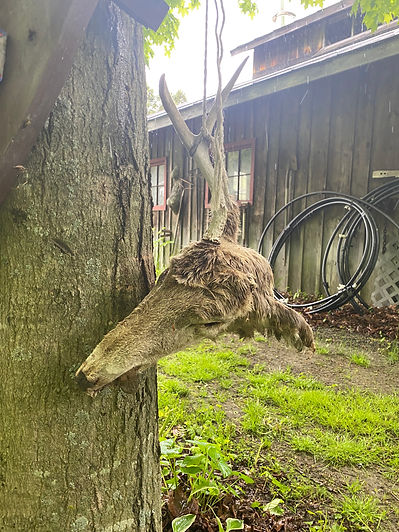
Draped from the maple tree in front of the sugar house was the severed head of a deer. Bob told me it was a baby. It lived in the woods across the interstate down the road and would occasionally trample across the busy road to Bettisville to graze on Bob’s lawn. “That was my deer,” he said. The deer returned time and time again. Then one day, Bob saw it on the side of Route 14, its lifeless head separated from its lifeless body. The aftermath of a reckless driver, or perhaps unlucky timing. We like to think the baby deer was on his way over to Bettisville. Either that or he was on his way back from a graze.
Bob stole the carcass and preserved the head, tied the antler to a piece of rope, and fastened I to a tree branch so he could stay at Bettisville forever.
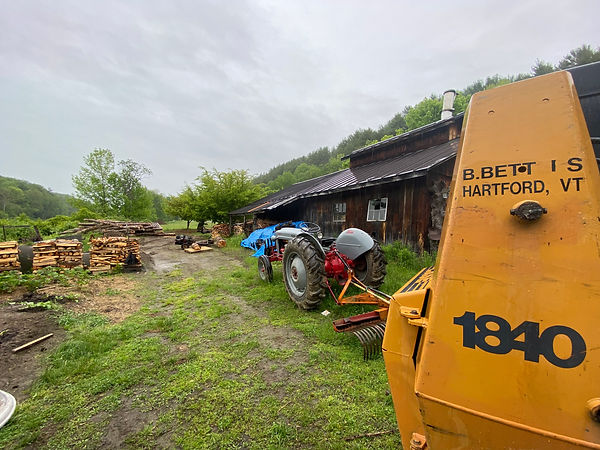
When I got to Bettisville for my second visit, it was pouring rain. Judy poked her head out the front door and told me to park in the driveway, so I backed out onto the road and pulled into the gravel driveway. It was hand-paved by Bob. He was out doing a work errand, Judy said. He’d be back in a bit. I told her I’d walk around to take some photos of the places he’d shown me last time. She insisted I wear her rain boots so I wouldn’t ruin my white shoes. I slipped them on gratefully, and she handed me an umbrella.

Raindrops splashed into the wheelbarrow by the strawberry garden, next to where Bob kept his firewood. Most of it would be used to heat the Bettis’ home this winter; the remains would be burned in the evaporator to make maple syrup. “Many people don’t know, that’s how you get good flavor, by burning firewood – it flavors the syrup,” Bob said.

Judy cleared the kitchen table so we could sit. She sat across from me, and Bob sat to her right.
“How did you two meet again?”
Bob responded. “You want me to tell you, really?”
“Yes. And Judy’s gonna tell me if it’s the real story.”
He replied spitefully. “Well why don’t we let her tell it then. Since I’ve always said it.”
Judy was smiling. “We just sometimes don’t remember things the right way.”
Robert and Judith Ann met square dancing or roller skating, depending on what night it was. “Saturday night was square dancing and Sunday night was roller skating,” Judy said. “He was a skating star.”
“I tore her leotards up,” Bob said.
“You knocked me down and made holes in my leotard,” Judy said.
“I tore them and had to buy her a new pair,” Bob said. “And she wanted me to put them on her.”
“Oh, I did not,” Judy retorted. “You go to a certain point and then you add on.”
“Well, you gotta add salt and pepper or it doesn’t come out good,” Bob said. “I was fifteen. Young and naïve.”
“You must have been seventeen, eighteen, maybe,” Judy said.
“Dear…”
“Seventeen and a half? Eighteen. Because I would have been twenty,” Judy said with a sort of finality. Bob turned toward me and nodded.
“Woody and the Ramblers was the name of the band that played,” Judy said. “I think now all of the members have passed away.” The din of passing trucks grew louder and then faded as one drove past the window.
“I used to sweep the girls right off of their feet roller skatin. Boy, they’d chase me like you wouldn’t believe. I was a romancer.” Bob’s voice was swaying now. “I was a wiiillddd man.”
Bob and Judy were both born in the same hospital, two years apart.
“The same doctor slapped both of us,” Bob said. But Bob grew up in downtown Hartford and Judy in Cornish, near North Hartland. So they went to different high schools. Bob went to Hartford High and Judy to went to Windsor High.
Bob’s childhood, it was lousy. “Well first, my sisters always picked on me.”
Bob Bettis was twelve years old when he started working as a laborer on local farms. He would get up at the crack of dawn to complete odd jobs for people in town, scraping by to make money for his family. His mom didn’t work, and his father drove the taxi in Windsor.
“Back in them days, it was hard times,” he said. “We didn’t have much food, you see how thin I am.”
He was the middle child of twelve siblings, who all lived in the same six-bedroom townhouse in downtown Hartford. “We slept on top of each other. We were warm. We cuddled.” Bob’s lived a hard life. He’s worked, all his life.
For some time, Bob was a short order cook at Lou’s Restaurant in Hanover, New Hampshire – he said he worked there ten years, but Judy thought it was closer to five or six.
“You would’ve been there in ’64,” Judy said. “Because we got married in ‘65.”
Bob and Judy shared their first place together on the second floor of a house on Greensboro Road in Hanover, New Hampshire. It was a matter of convenience, this locale. Soon after, Bob and Judy bought a trailer and moved into a park in Wilder, until Bob left Lou’s in 1970. Then they moved to the land across the interstate. They lived there for a year and a half, then in 1988, they bought the farmhouse and land on Jericho Road.
It came with all seventeen acres in the valley by the river and tens of acres of the upper farmland. It included their farmhouse on the hill and the land that stretched behind it to the railroad, and the spotted green space to the left and right of it, and up and down the river’s bank to the bridge.
Judy’s mom was looking for a new place. “She was retired, and she hadn’t made much money in her life,” Bob said. Judy added that real estate was getting pricey in Windsor, Vermont.
“She was broke. She didn’t have no money. She worked all her life, making shoe soles,” Bob said. “What happened is she got pneumonia, and she was in the hospital,” Bob said.
“And that was right around when they started increasing the rents again,” Judy repeated.
“So, I went to the hospital, and saw her, and told her if you get outta here, I‘ll build you a house. And I did,” Bob said proudly. On the patch of land sitting between river and road, he recruited his construction guys to help him build it.
“I’m impressed,” I told him.
Bob immediately replied. “Do you want to buy it?”
Soon enough, Judy’s mom was living comfortably at the little house on Route 14 in White River Junction. She lived here on her own for almost ten years. “’88 to ’97, I think it was,” Judy said. She lived there until she died.
When Judy’s mom passed away, one of the Bettis daughters moved in with her two boys, Weston and Tyler. Weston was a star basketball and baseball player, Bob said. He showed me pages from a photo book his daughter made for them.
“You should’ve been here earlier,” Bob told me. “When the boys were here. Judy, show her the picture.”
“What picture?”
“Show her the picture of Tyler and his friends, on your camera.” Bob insisted. He turned to me. “That way you can see what he looks like.”
“It was a picture of him at his Junior Prom,” Judy said. Him and his friends drove to Bettisville to line up for photos behind the house.
“I don’t know where it is on the camera, Bob. That’s why I hesitate to show her.”
“You’re lazy,” Bob retorted.
“I’m not lazy,” Judy said. “I’m practical.”
“I want her to see what she looks like, that way she might be more interested,” Bob said.
Judy hushed her voice, almost to a whisper: “He’s too young, he’s only seventeen.”
“Oh, that ain’t young,” Bob replied. Judy was slightly embarrassed. “Alright, let’s get back to her questions.”
“I fell in love when I was fifteen,” Bob went on. “I fell in love with my schoolteacher when I was twelve.”
“Okay,” Judy said.
“She was eighty. But she was experienced,” Bob replied.
…
Bob and Judy moved down the hill from their Jericho Road farmhouse to Bettisville in 2004. Or something like that. Bob says he doesn’t keep track of dates. But Judy knows. She says it was Labor Day weekend when they sold the farm: twenty acres of farmland on the hill, which sat on the middle of a gravel road, so that either direction you took out of the front door went down to Route 14. The property had an outhouse, a kitchen, eight bedrooms, a woodshed, a summer kitchen and a maple sugar shack. And cows, chickens, and pigs. At some point, there were horses. Bob and Judy sold the contents in an auction. “There was a lot to get rid of,” she said. To Bettisville they moved.
Bettisville was a product of years of weathering, building and rebuilding. In 2011, Hurricane Irene pummeled the Northeast and flooded the White River Valley, hitting the homes by the banks of the White River. Bettisville was not spared. The water level had risen so high that Bob and Judy had to evacuate their home.
The first monument Bob showed me was his wall dedicated to Irene. The slabs of stone were neatly piled and stacked atop each other, to the side of his sugar shack. He credited the stone work to his years of experience. Bob laid all of the stones by hand; they were stones he dug up when he was plowing his farmland. The red wagon wheel which was nestled in the piled stone—he picked it up, he says.
“The water came all the way up to here,” Bob says. He motions toward the wall. It stood around four feet, a marker of how high the water rose during the flood. It washed out a lot of the sugar shack in 2008. But Bob and Judy repaired the damages. It took nearly two years. Bob built this monument to commemorate the storm and their resilience. The sign that sat at the base read “Bob” and “Irene,” with “Judy” crammed into the corner. But this sign was not the original.

The original sign was hand fashioned by Bob and read “Goodnight Irene,” a reference to the song and the storm. But in 2014, the sign vanished. Whether it was stolen, taken by the wind, carried off by vultures, no one knows. It mysteriously vanished. Bob and Judy never filed a police report.
Bob made a new sign – the one that stands today. It’s just life, Bob said. You get back up again when you get knocked down. Things can be repaired, rebuilt. Like pollution, as Bob would argue. Like this country.
“The river out here was so full of sewage, you couldn’t even go out and fish,” he said. “They cleaned it. This is how much we’ve improved, you know. We ruin something, but we turn around and try to rebuild it.” Bob says this is the state of the country right now, that we’re in a phase of rebuilding.
“This is the greatest country in the world. And look how was it made that way,” Bob said. “Look what’s happened in less than a year. Trump built a wall to control people coming in from wherever, then this guy gets in office.” Bob was talking about the current president.
“Do you don’t want them to build the wall?” I asked.
“Yes, I want them to build the wall! I want them to control our borders. We control the Canadian border. It’s still closed. More money comes from Canada than comes from Mexico. All these immigrants come across the border, and no one even knows who they are.”
“He shuts down a pipeline. Completely shuts it down. For our oil, for the East Coast! Our oil, gas and fuel. He don’t buy fuel.” Bob was riled up.
“And the argument for that was it was bad for the environment?” I asked.
Judy nodded. “Yes, well…”
“We can say all this stuff is bad for the environment,” Bob says. “I mean, pollution is pollution. You have to have cars to get back and forth to and from work. They shut all the trains down so now all your stuff comes in by truck. The railroads are all gone now. Who did that?! The government.” Bob pointed to the front door of the house, which faced the tracks.
“See this railroad right here? I used to see five or six trains a day here and when I was a kid, there was almost a hundred trains a day on this track. I could never quite figure out why they shut the railroads down. I mean railroads are what made this country.”
Further from the sugar shack was a patch of grass, about the size of a soccer field. This was where Bob showed me his Trump Wall. Like the Irene monument, the Trump Wall was stone-work made from old pieces that were going to be discarded. Except these were a lot larger. He could only move them using his tractor.
“I was doing a job, and we dug out all of these stones. They told me to throw them away, that they ain’t no good. My grandson was working with me; he was running the bull-dozer. I loaded the stones in my trailer -- loaded them up and dropped them here. I brought them all home,” Bob said proudly.
Tucked between the stones’ jagged edges were Trump/Pence campaign posters. Bob built his wall when Trump first ran for president, in 2015. “Has it been that long ago?” Bob asked.
“Well look at the size of the trees,” Judy pointed. “Flowering crab apple trees of differing colored blossoms,” was how Judy put it -- slumped over the stone slabs and shaded the wall.

“I’m a Trump Man,” said Bob. “And I’m very proud of it.” Bob continued.
“When he was elected in 2016, he said he was gonna build a wall, so I thought I’d build one, too. That’s my Trump Wall.” Bob proudly described his work. He pointed to slabs of stone and teddy bears tied to posts tucked between the stones so they couldn’t fly away. Their sad, pilled fur was crisp and stained, evidence of weathering. Of days and weeks and months on the wall, of miserable rain-soaked nights and days of hot sun which dried their coats.
“Those are the animals,” Bob said. “They’re trying to climb over the wall.” He laughed.
“Why do you call them animals? Do you not want them to come in?” I asked.
“Oh, no they’re friends. They can come in, work jobs if they want.” I wasn’t sure if Bob was being truthful here, or if he was joking. Sometimes Bob said the exact opposite of what he means to say. He did this a lot.
In front of the wall stood a large striped signpost. “There was supposed to be a sign hanging from that,” Bob told me. But he never got around to finishing it, and these days he couldn’t work as much. He had open heart surgery last year. He wanted to write the names of his grandchildren on the sign, but he never got to it. He said he likely never will.
We continued to walk along the grass. Bob grabbed a stick and leaned on it with each step. He was looking down, getting his bearings among the field. I followed as we circled around the lawn. Then he halted and lifted his stick, pointing forward. “Won’t you look at that,” he said.
“It spells Trump! T-R-U-M-P. I’m a Trump guy.”

Bob had sprinkled fertilizer to spell out the letters in the grass, which weren’t visible to me until the moment he pointed them out. From then on, I couldn’t unsee them.
“Sometimes things are hidden in plain sight,” Bob said. “You just saw three things you didn’t know were there before.”
…
Back inside, Bob talked politics. Bob talked Trump. I wanted to listen. But first, we talked about breakfast.
“We haven’t used an alarm clock for years and years,” Judy said. Every morning, Bob and Judy follow the same routine. Bob gets up at five and gets breakfast with his retired contractor friends. Judy gets up at six, and when he gets back, they eat together. When he has his second breakfast, she has her first. “He cooks what he wants,” Judy said. “Sometimes its Cheerios, sometimes its Wheaties, or sometimes it’s pancakes.”
“French toast,” Bob adds.
“Sometimes its ham, sometimes it’s French toast,” Judy said.
…
At this point, Bob had gotten up and poured himself a glass of cranberry juice. He offered me a drink, as he always did.
“You gotta have somebody, you know, that you trust. And I trusted Trump. I still trust him today,” Bob told me. Judy looked nervous.
Before returning to his seat at the table he stood by Judy’s side. She was sitting. I couldn’t see her legs. I think she kicked his shin. I could tell Bob was used to defending his views. I was sensing he felt he had to do the same with me.
“For me, he told it the way it was. Whether it was a lie, I don’t know. But I took him as his word.”
“If what was a lie?” I asked.
“Whatever he said,” Bob replied. “He was upfront. He took the bull by the horns and he rode it,” Bob said. “You know, I’d vote for him again. As a matter of fact, next time he runs I’ll send him ten dollars.” We laughed – Bob and I. He thought himself pretty funny, I giggled nervously.
“Everybody laughs about my wall out there,” Bob says. His tone shifted from proud to reticent. I asked him if his friends were Trump supporters.
“We don’t talk politics,” he said. “I have my Trump wall, but that’s my wall, that’s mine. That has nothing to do with my friends. They pick on me about it. Because they’re Democrats, but it don’t bother me, because they’ve got broad shoulders and -- hey, I grew up in the hard days of life. I know what it’s all about. But that’s my opinion.”
Judy sat patiently. “We’ve found it’s very much easier to live and still remain friends, if, in our travels, we don’t discuss politics.”
“A lot of people think that if you support Trump, you’re a bad person,” I said. “Do you not want me to write about your political views?”
“Oh, no I don’t care,” Bob interjected. “No way, I’m proud of it.”
“Other than a reference to the wall, that’s …” Judy added.
“It’s a TRUMP WALL!” Bob interjected.
“That’s… what it is,” Judy muttered. “I think what he’s trying to say is… he liked Trump, because Trump seemed like the man who was determined to get something done for the benefit of everybody. And he took on a lot of bureaucracy to try to straighten things out,” Judy said. “He was fighting against the taxes, and fighting this and that. And arguing against this and that…” she trailed off.
“I think he’s for the working man,” Bob said. “Black collar, white collar, blue collar, dirty collar, whatever it is.” His voice was rising. “That’s where I stand and that’s why I vote for him. I stand beside him. I stand beside him because he’s a man of his integrity, or whatever.” Bob said.
“There are lots of things I don’t agree with him on…” Bob said.
“Like what?”
“Well, I don’t know about the campaign politics right now, but I don’t agree with him on –”
“Twitter,” Judy interjected.
Bob picked it up. “If he’d sometimes just shut up. You know, just plain shut up. Leave it! Like you tell a dog. LEAVE IT!” he yelled. “But I’ll tell you one thing, right now. You’re young enough, you’re gonna see it. Mark my words, you people all are gonna wish you never saw or heard of the guy named Biden. He’s gonna run this country right into the ground like you ain’t gonna believe.”
“Look what he’s already doing! Look at the price of oil, look at the price of gas! Look at price of food! That’s all because of him,” Bob goes on. “Shut down an oil pipeline. Opens the border. FREEEE, come on in! Yeah, we are a free country, but I’ll tell you right now, that ain’t good. Its gonna come back and haunt this country. We won’t see it, but you kids will. And you’re gonna say, oh God, that old fart was right.”
Judy laughed.
Bob’s tone became serious. “You’re young. You haven’t the fuckest idea what’s going on in this country. I’m telling you as a friend. You don’t – it’s just so mindboggling, what this guy can keep doing! So much, I wonder how he don’t get shot!”
He sunk back from his upright position in the wooden chair at the table, shifting himself on the circular multi-color knitted seat cushion.
“That’s my opinion. That’s all I’m gonna say about politics.”
“Don’t say anything about politics. It gets everything too riled up,” Judy said.
“That’s right. I HATE POLITICS!” Bob said sarcastically. “Now I’ve turned into a democrat. Now say nothing.”
I tried to offer a concession. “My professor is very liberal…”
“Ohh if she’s got a liberal professor, he doesn’t see anything except his point of view!” Judy said.
“There you go,” Bob added.
“I want to write my story,” I said. Judy’s face grew worrisome. “You won’t get a good grade, so don’t bother.”
“No. don’t do that. Your gonna beat yourself up,” Bob said.
“I want to,” I said.
Judy was worried now. “Understand, understand the difference,” Judy said. “But work for your grade. That’s my advice.”
“That’s right,” said Bob. “Work for yourself.”
“Work for your grade,” Judy said. “If you know the way your professor stands on stuff,” don’t push his buttons too much.”
“Don’t light the match unless you can put it out,” said Bob. More laughter.
“I’ll take the risk,” I said. That’s what a good journalist does. Right?”
“Okay,” Bob was growing worried. “That’s exactly right, but there isn’t any such thing as good journalism.” Both Judy and Bob were garnering genuine concern for me.
“She’s trying to be,” Judy said. They looked at each other.
“I know she is, but she gonna get hurt,” Bob said.
“I know she is, dear.”
Bob turned to me. “You’re gonna get hurt like you ain’t believed.”
“To get your way through your schooling…” Judy started.
“That’s right,” Bob interjected.
“You gotta play a little bit of their game,” said Judy.
“Well, you get kicked out of college, you can come live with us,” Bob said.
Judy laughed. “Or go back home.” I was sitting at my chestnut chair, listening to them both.
“I think your mention of the Trump wall in your article will be enough to set your professor off.” Judy said.
“You’ll have to see,” Bob added.
“I want to see.”
“Wait a minute. Don’t - we don’t want to see you get… don’t get hurt, please,” pleaded Bob. I could tell Judy and Bob were accustomed to resistance to their politics. They were trying to impart their wisdom to me.
“Don’t hurt yourself by tryin’ to push that button. How long as he been there? Is he a full-on professor?” Judy asked.
“Yeah.”
“Okay. Then don’t do it.” Judy advised. “You’re not gonna change his mind. You’re not gonna change his outlook. You’re not even gonna make a dent in his shield,” Judy said.
“I know I’m not going to change his political ideology—"
“This is your idea,” Bob jumped in. “This is your life. This is your heart.” I was taken aback by the care in his voice. I was a stranger but I didn’t feel like one any longer.
“Give him a little firecracker, not a big cannon” Judy said.
“Give him a match, don’t give him a bomb,” said Bob.
“Alright. What’s your next question?” Judy asked. “We don’t want you driving home in the dark.”
“Did I tell you I gave her a little jug of maple syrup?” Bob turned his glance toward Judy.
“See, that’s the Trump way. Give.” She laughed.
“Really? Is it?” I responded.
“That’s right.”
“Or is it—do what’s best… for yourself?”
“You know what it is?” Bob said. “I had a young lady in the sugar house, and she ain’t gonna stop in life, she’s gonna go all the way to the end, and don’t stop. Don’t let nothing slow you down. Keep going.” He pounded the table. His voice was louder now. Go to the top.” He said this with conviction. I’d never felt scolded, reprimanded and loved at the same time. Judy was laughing a little to cut the seriousness. But I looked Bob in the eyes.
“Don’t take any bullshit. Just do it.”
I felt I owed it to Bob to write his full story. To tell his truth, because it was true -- Judy and Bob sometimes concealed their political views to avoid confrontation with friends, but the truth was beautiful. Bob and Judy were beautiful. At their chestnut table, they were unapologetically truthful to me. In the mustard yellow kitchen light, they were not people I disagreed with; they were themselves. Their caring, empathetic, self-conscious, angry, confused, wonderful selves, and that was beautiful; they were beautiful, and I felt loved. At least, as much as a stranger could feel.
…
“Bettisville is a special place right here,” Bob said. “I know you got the roads, you got the railroads, and you got the interstate. But you got the river. But you sit out back here, you don’t hear that stuff. It’s a little castle in a mountain.”
“You have neighbors, but you don’t have neighbors,” Judy said. “And you have people all the time. But you don’t have people all the time because they’re coming and going.” Far enough from Hartford village for a taste of nature but close enough for errands.
I asked Judy if Bettisville meant any more to her since it was built for her mom.
“Not really.” She said. They built the home with the prospect of one day moving in, she told me.
…
“Is that what you’re gonna to do in life? Journalism?” Bob asked me.
“I think so. Maybe. Do you not see me as a journalist?” I asked. Neither answered. “What kind of journalism? Newspaper?”
I said I wasn’t sure. People sometimes just tell you what they know you want to hear,” I said.
“Well, it takes a good journalist to get down to the bottom of it all,” Judy said.
“But that’s life,” Bob said. “I mean, it’s like sales. They’ll tell you whatever you wanna hear.”
I nodded. “Like you guys talking to me right now. You can just tell me only what you want me to know.”
“I’m telling you the truth,” Bob said.
“With a little bit of salt and pepper,” Judy added. We laughed. “We need to help her follow up with her fact-writing,” Judy said. If that’s what her professor expects her to have, we’re having to help her do it.”
“You can just make stuff up and no one would know,” Judy joked.
“Well, that would be bad journalism,” I said. “Plus, shouldn’t I bulldoze my way through life, make it to the top, don’t stop for anyone?”
Bob laughed. “I’m surprised you aren’t a Vermonter.”
On Flag Day, Bob will decorate the property with American flags. He loves the flag. Bob says again that we live in the greatest country on Earth. Him and Judy have taken their humble trailer all over the country. They’ve camped in but three of the fifty states: Minnesota, Washington, and Oregon.
There is a yellow boat tied to a birch tree on the rocky rapids across the street from the Bettis’ home. Sitting in the kayak is a beaten-up teddy bear. He’s strapped in. Bob says the yellow kayak has been there for ten years. A few years ago, the police got worked up about it; they thought it was a stranded boat, or an accident. They wanted Bob to remove it. Bob thinks the police have bigger problems to deal with. This is Bettisville humor.
There are lots of unfinished projects around Bettisville. Bob says they’ll go unfinished like the signpost on the candy cane post which was never erected.
“I don’t have the energy anymore, I don’t have the ability to work, and I’m just plain lazy,” he said.
“Well, we’ll have to have you over for dinner sometime,” Judy said.
I said I’d love that.
“This is what I’m trying to do tight now,” Judy says. She holds up her digital camera to me and in the other hand she holds a notepad with a list of photo descriptions and dates. “I’m trying to make a photo book,” she said. “It’s hard though.” The photos take a long time to upload. “We don’t have internet here, so that might be why.”